
Installation and monitoring of a railway track bed using ballast enhanced with recycled rubber
DEMO3 represents a real-environment testing field for an innovative ballast solution incorporating recycled rubber particles and lateral concrete elements, implemented on an existing railway site.
Within the efforts dedicated to circular solutions for railway infrastructure, a new type of ballast incorporating recycled rubber components has been developed, implemented, and tested. The objective is to upgrade and validate railway track solutions that can contribute to reducing noise and vibrations while supporting more sustainable infrastructure practices. The innovative ballast solution was selected for implementation on a full-scale pilot track, known as DEMO3. The Institute of Traffic and Transport Ljubljana supported the deployment of this pilot section on an existing railway track.
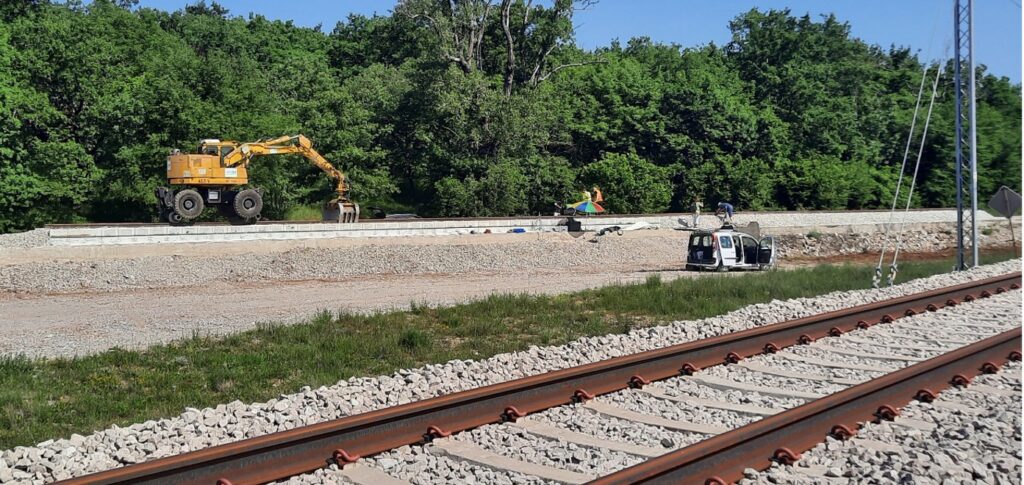
The whole test field, 60 m of railway track with the excavator used for monitoring
The test track section designed to evaluate the performance of ballast with rubber additives consists of two connected segments with a total length of 60 metres. The first segment includes a 30-metre ballast bed containing ballast mixed with recycled rubber, enabling the assessment of acoustic and vibration characteristics. The second segment consists of a conventional 30-metre ballast bed used as a reference section. The same type of reference ballast was applied in both segments to ensure comparable testing conditions.
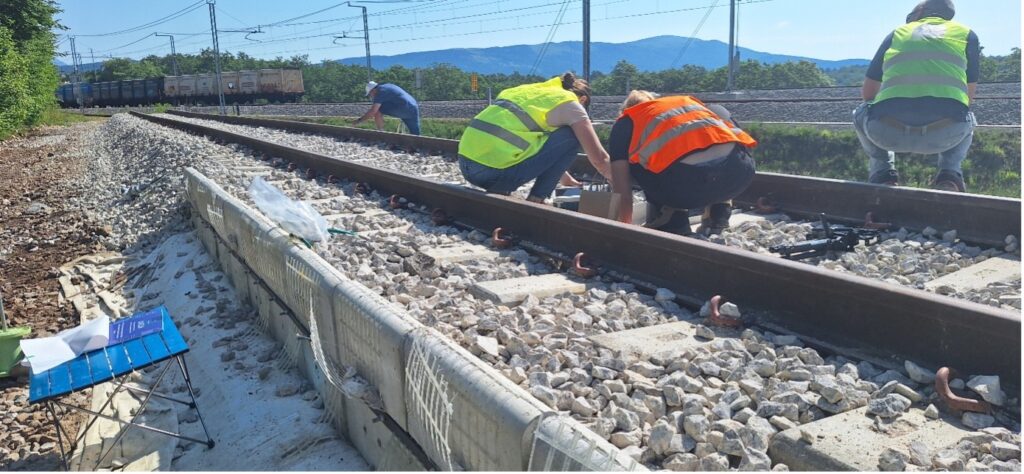
Installation of the monitoring equipment on the new ballast track bed and on the conventional ballast track bed
The test field was constructed on the abandoned route of the Divača–Rodik railway line, near Divača station, in mid-May 2026 . The inspection and documentation of the test field, together with monitoring of settlements, vibrations, and noise levels for ballast with and without rubber additives, were carried out on 25 May 2026 in cooperation with ZAG, the organisation responsible for developing the innovative ballast solution based on recycled rubber.
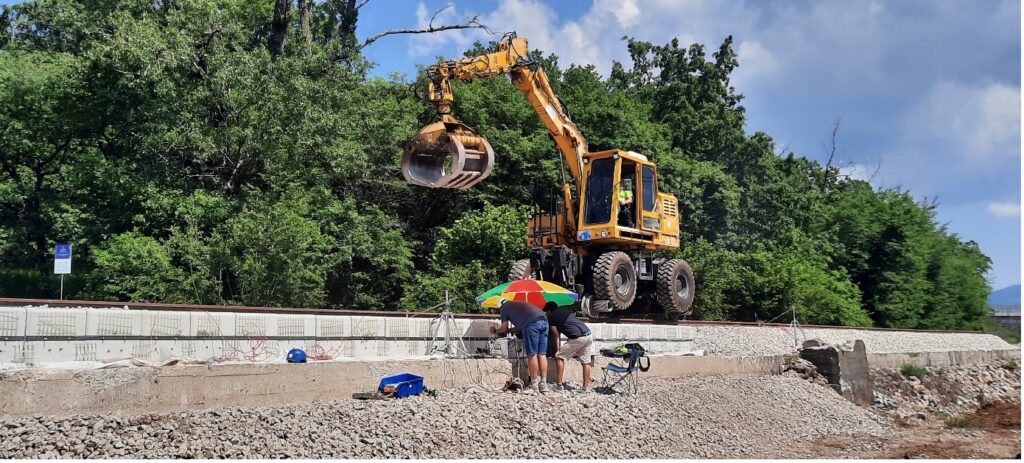
Excavator during monitoring
Monitoring activities were performed during the passage of a dual-mode rail vehicle, a heavy-duty machine that repeatedly travelled across the test section. Several sensors installed on the ballast bed collected data to evaluate the behaviour and performance of the new track solution. The appearance of the track bed and the testing activities using the dual-mode excavator are shown in the photographs below.
At this stage, the “CIRTRACK” test field is not intended for operational railway traffic. However, it represents an important first implementation of an innovative track bed solution in a real environment. The results obtained provide valuable insights for further research and future assessment of the benefits that recycled-rubber-enhanced ballast could bring to railway networks in operation.
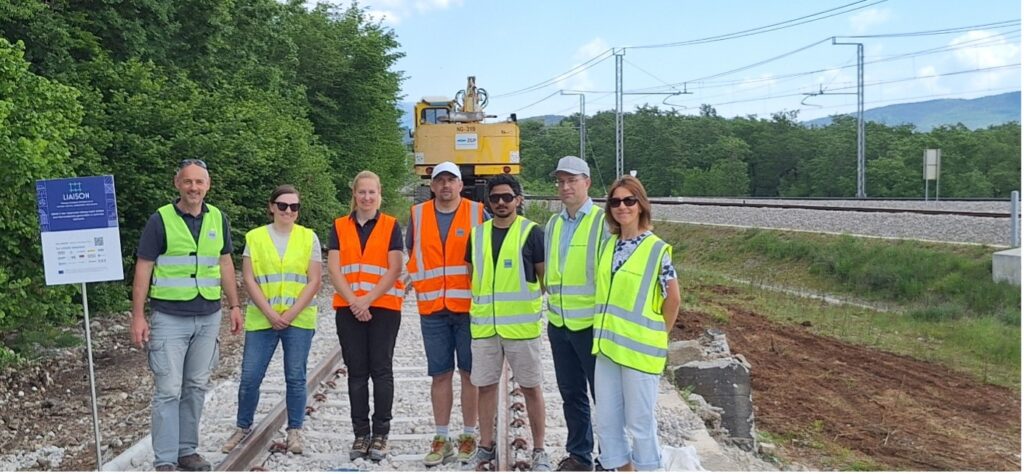
The test field implementation team, from the companies ZAG and Institute of Traffic and Transport Ljubljana