
As the EU advances toward greener infrastructure, materials innovation is becoming crucial. Concrete, an essential material for the construction of major infrastructure and the mainstays of Europe’s transport network, is a major contributor to carbon emissions due to the energy used to produce clinker, the principal component in cement composition. Through its demonstration site in Poland’s Podkarpacie region, the LIAISON project is exploring how geopolymer concrete can reduce environmental impact while maintaining road performance.
Rethinking the road
Given that cement production is a major contributor to global CO₂ emissions, there has been an increased use of industrial byproducts, especially in construction, as partial substitutes for cement. Nevertheless, their potential has not yet been fully exploited, despite their environmental and economic benefits. LIAISON tack the challenge by testing alternative materials that lower carbon emissions and support circular construction.
In southeast Poland, a stretch of road within a precast tunnel element production facility is serving as a live testing ground for these innovations under real traffic and climate conditions.
Innovations on the ground
A key technology is being trialled:
- Geopolymer concrete: a novel cement-free concrete, produce by activating industrial byproducts – fly ash (FA) from carbon thermal power plants and ground granulated blast furnace slag (GGBS) from iron and steel production- with a chemical activator, offers a significant reduction in pavements carbon footprint.
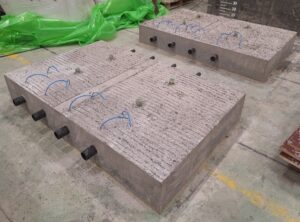
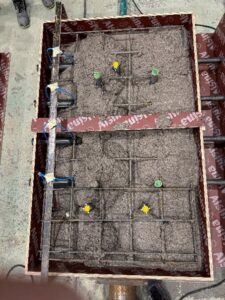
As part of this effort, LIAISON partner ACCIONA has developed its first small-scale prototype of a precast modular slab made entirely with geopolymer concrete —with 0% clinker. These prefabricated slabs offer benefits in manufacturing, installation, maintenance, and end-of-life recycling, supporting both efficiency and sustainability.
From pilot to practice
The project is assessing the workability, mechanical performance and durability of these material, while also evaluating their integration into standard construction processes. An advanced weight-in-motion (WIM) system, based on Fiber Bragg Grating (FBG) sensors, will be integrated into the slabs, enabling real-time monitoring of vehicle weights. This technology helps identify overloaded vehicles, which can induce with time structural and safety problems, contributing also to improved infrastructure management.
If successful, these solutions could reduce the environmental footprint of road construction while valorising local industrial residues—contributing to the EU’s Circular Economy Action Plan and sustainability taxonomy.
A model for the future
The Polish demo site is part of LIAISON’s broader ambition to provide scalable, transferable solutions for greener transport infrastructure. Findings will feed into practical guidelines for road authorities across Europe.
With support from partners like ACCIONA, and thanks to the work of engineers and material specialists across the LIAISON consortium, this initiative is helping to reimagine the road from the ground up—proving that the shift to low-carbon transport can begin with the materials beneath our tyres.